 Cambria
 Cambria Islands host Islets that supply crops and raw materials
Cambria Islands host player-owned Islets that produce crops, fish, ore, and fiber. These smaller properties anchor to larger Island hubs, where shared buildings support resource processing. An Island NFT represents the host property; a settler purchases an Islet as a working space. In the First Landing ruleset, production combines seed-based farming with Energy-consuming extraction. Cooking, Smithing, and Crafting turn suitable inputs into finished goods for the Supply Drive. Under Dungeons patch v0.3.0, cash-ins convert Royal Favor directly into Genesis Points after Island tax, with applicable multipliers. Host access policies, crop health, and weekly stock clearance affect that work. Expanded storage and guild infrastructure belong to the development plans.
Opening an Islet for resource production
Resource interaction on an Islet requires a built Storage Chest, so acquiring the property alone leaves an important construction prerequisite. Registrar Joryn handles Islet purchases in the Chancery of the Archipelagos within the Dungeon Lobby. Dungeons patch v0.3.0 sets an Islet purchase at 50 Dungeon Keys with starter supplies. The purchase includes a choice of host Island. That selection shows the holder, biome, tax rate, and hosted Islet count.
Chest construction uses Rough Stone and Planks. Wood becomes Planks at the host Island's Sawmill. The built chest unlocks resource interaction; the placeholder does not. Gathering also needs the equipment and consumables that its particular activity requires.
Host Island access and settlement capacity
An Island's admission policy determines whether a settler can place an Islet there automatically or needs approval from its owner. The v0 administration options include Open, Invite-Only, and Closed states. Owners can review placement requests and remove hosted Islets. Choosing an Island therefore establishes a relationship with a particular landholder, alongside access to its production hub.
Base hosting capacity follows Island Size Tier in v0: Tier 1 supports 5 Islets, Tier 2 supports 10, Tier 3 supports 20, Tier 4 supports 40, and Tier 5 supports 60. Capacity-expanding upgrades remain planned. The initial v0 tax setting used a 5% default with owner adjustment disabled. Dungeons patch v0.1.3 enables an owner to adjust one Favor tax rate across all their Islands, retaining the 5% default.
Farming plots, seeds, and disease
Farming requires an upgraded farm and usable seeds, with crop health affecting the growing process. Farming v0.1 does not consume Energy.
Seeds and crop progression
Fishing, Mining, and Gathering can supply seeds, and the First Landing v0.3.8 update also adds seeds to Sergi's Shop. Crop tiers have their own Farming level requirements and growth durations. Higher tiers need greater Farming progression; a mature crop supplies a harvest, while a seed supplies the next planting. Husbandry also allows collection from herd animals on an Islet.
Compost and crop health
Compost heals diseased crops, and the Composting Bin converts scraps into that treatment. A growing plant's health remains separate from its maturity. Disease treatment addresses the health problem; harvesting requires a crop that has reached its harvestable state.
Fishing, mining, and fiber gathering
The chosen extraction activity determines which raw material an Islet supplies and which production skill can use it afterward. The resource families have different tools, consumables, and processing destinations.
Fishing equipment and catches
Fishing requires a Fishing Rod and Island Worms, which each catch consumes as bait. Fish supply Cooking. The First Landing rules allow biome-dependent secondary ingredients on catches of Tier 3 or higher fish, so the host biome affects that additional output.
Ore and fuel materials
Mining supplies ore for Smithing, including the inputs used for bronze and iron production. Coal contributes to steel recipes. Woodcutting supplies Wood, which the Sawmill processes into Planks for construction and applicable cooking recipes.
Fiber for cloth
Gathering supplies Fiber for cloth production at the Crafting Station. Raw Fiber also supports player trading, giving it a separate use before refining.
Energy consumption and replenishment
The extraction tier determines the Energy debit for Fishing, Mining, and Gathering under the First Landing schedule. Tier 1 costs 200 Energy per action, Tier 2 costs 400, Tier 3 costs 800, and Tier 4 costs 1,600.
Energy Orbs provide an in-game replenishment route through USDC purchases. Dungeons patch v0.1.3 also provides tenant Energy through the host's Energy Collector. Shares depend on Favor productivity; higher host taxes enlarge the pool. Island NFT ownership, upgrades, and Arena Token maintenance sustain it. Spending Energy supports the selected extraction activity, with possible rare drops alongside its ordinary resources. Rare drops are not guaranteed on every extraction action.
Cooking, Smithing, and Crafting
A finished good requires the inputs for its specific recipe, with Cooking, Smithing, and Crafting serving different resource families. Fish become food, ores become bars, and Fiber becomes cloth. Most higher-tier cooking recipes also require Planks as fuel. Raw ingredients and fuel therefore contribute separately to the same production task.
The main Island's processing buildings connect Islet extraction to finished production. Refining creates the goods; submission to Quartermaster James converts Favor into Genesis Points under Dungeons patch v0.3.0, after Island tax and applicable multipliers.
Supply Drive rewards and First Landing clearance
First Landing awarded Royal Favor for eligible goods submitted to Quartermaster James. Dungeons patch v0.3.0 converts Favor into Genesis Points at cash-in, after Island tax and with applicable multipliers. The award can vary with relative supply and the priority conditions that apply to a particular item.
Farming v0.1 adds harvested crops as eligible submissions. Its crop points do not receive the demand multipliers or priority bonuses that affect other applicable Supply Drive items.
First Landing clears refined goods weekly on Sunday at 3 p.m. Eastern Time. Food, Bars, and Cloth fall within that clearance rule. Those finished goods must reach the Supply Drive before clearance to contribute Royal Favor.
Dungeons patch v0.3.0 also retires weekly Favor and Trinkets in favor of Genesis Points.
Can trading raw resources replace gathering?
Buying inputs cannot replace producing the fish, ore, and crops bound under Dungeons patch v0.1.3. Earlier First Landing rules list raw fish, ore, Fiber, secondary ingredients, Wood, Planks, and Stone as tradable. The v0.1.3 follow-up restores trading for Island herbs and Coral Atoll refining materials.
Finished Food, Bars, and Cloth have separate restrictions: the First Landing rules make them nontradable. Purchasing a raw ingredient therefore leaves the production and submission work outstanding.
A scrap-to-compost example
In this hypothetical Farming v0.1 case, an Islet holds 16 scraps and has a healthy growing crop. The Composting Bin's recipe uses 3 scraps for 1 compost. Converting five complete recipe batches produces 5 compost and leaves 1 scrap.
The healthy crop can continue growing without disease treatment. If disease develops, apply compost to treat the crop. The available compost supplies treatment material, although producing it does not itself heal the plant.
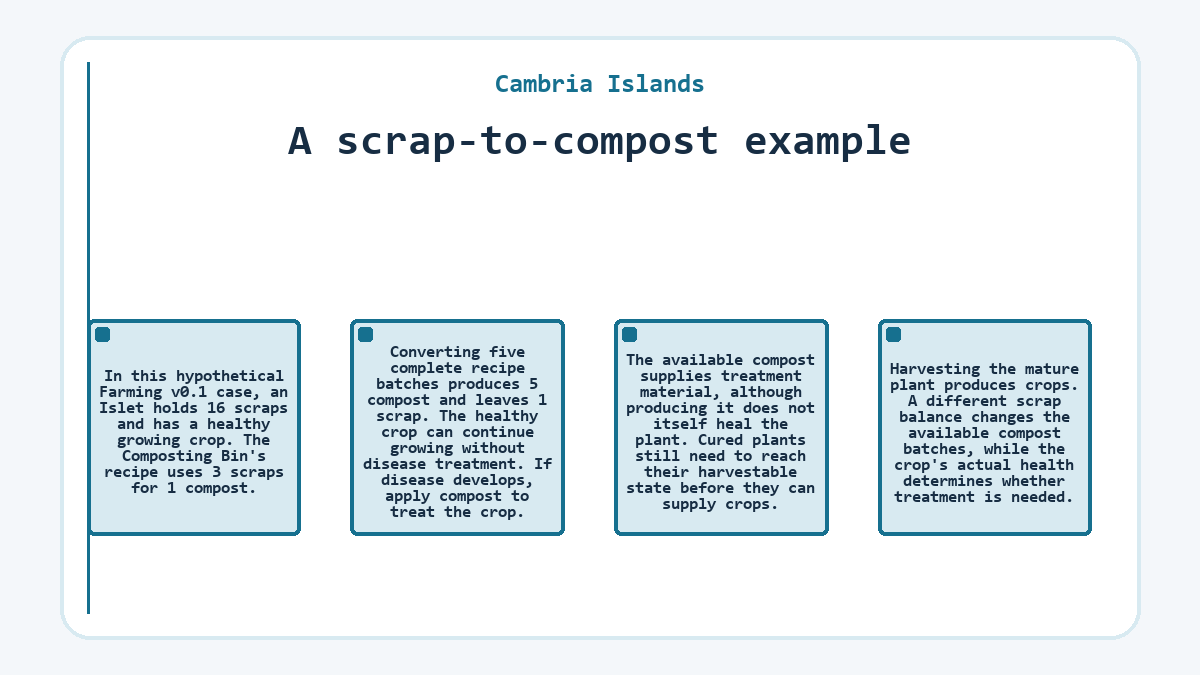
Cured plants still need to reach their harvestable state before they can supply crops. Harvesting the mature plant produces crops. A different scrap balance changes the available compost batches, while the crop's actual health determines whether treatment is needed.
First Landing Islets at the release boundary
The First Landing rules provide for Islet use throughout that season and its playtests or Gold Rush Testnet. At the Gold Rush release specified for that transition, the rules require an Islet reset and another purchase.
An Island NFT and a purchased Islet consequently have different continuity rules. Holding the host-property NFT does not remove the Islet reset requirement. Legacy Arena Token features may have ended or may be under rework, so their First Landing purchase and distribution rules have a specific version scope.
Active production beside planned shared infrastructure
Working farms and extraction activities support Islet production, while several broader settlement services remain in development. Expanded Banking and Storage, achievement displays, guild infrastructure, cross-mode building taxes, and coordinated Supply Drives appear as work in progress in the wider Island design. Their planned roles connect Islands with Dungeons and Gold Rush without making every shared service available.
The larger settlement design includes docks, the Overlook, and communal production buildings. An Islet concentrates personal farming and resource work; a host Island adds administration and the infrastructure that supports its community.
Useful questions about Cambria Islands
-
Can the same Fishing Rod handle every Islet fishing tier?
- The standard Fishing Rod supports all fishing tiers in the First Landing ruleset. Island Worms supply the bait, and each catch consumes them. A rod's tier compatibility does not remove the need for bait or the Energy charge for the selected extraction tier.
-
Which Islet farming activity can return replacement seeds?
- Harvesting crops has a 25% chance to return seeds under the First Landing v0.3.8 rules. Seed recovery is a possible harvest outcome, so a previous planting does not assure a replacement seed. Each new planting still requires an available seed.
-
Does an Island holder's Royal Favor bonus determine the settler tax rate?
- The holder bonus and the settler tax rate govern separate calculations. The initial v0 rules specify a weekly holder bonus of 15% of Royal Favor earned through Supply Drives under the Island. The initial v0 tax defaulted to 5% with adjustment disabled. Dungeons patch v0.1.3 enables one owner-adjustable Favor tax across all their Islands, retaining the 5% default.
-
What changes when an Islet moves after eviction?
- The announced Islet migration design preserves buildings, progression, and stored materials when the settler anchors to another Island. Eviction places the property in Pending Migration. Some upgrades and resource synergies that depend on the previous host may disappear, so moving preserves the Islet while changing its host relationship.
-
How does Super Compost differ from ordinary compost on an Islet?
- Ordinary compost heals diseased crops, while Super Compost also grants a farming plot 24 hours of disease immunity under Farming v0.1. Super Compost cures existing disease when applied. Its protection concerns disease on the treated plot; the crop retains its own growth requirements.
-
When does an Island NFT qualify for First Landing Islet-purchase distributions?
- The initial First Landing v0 distribution rule excludes Islands sold during the three weeks before the snapshot. That purchase-revenue pool uses Arena Tokens and Island Size Tier weights, with monthly distributions. This eligibility condition applies to Islet-creation revenue and remains distinct from the host's weekly Supply Drive Favor bonus.